


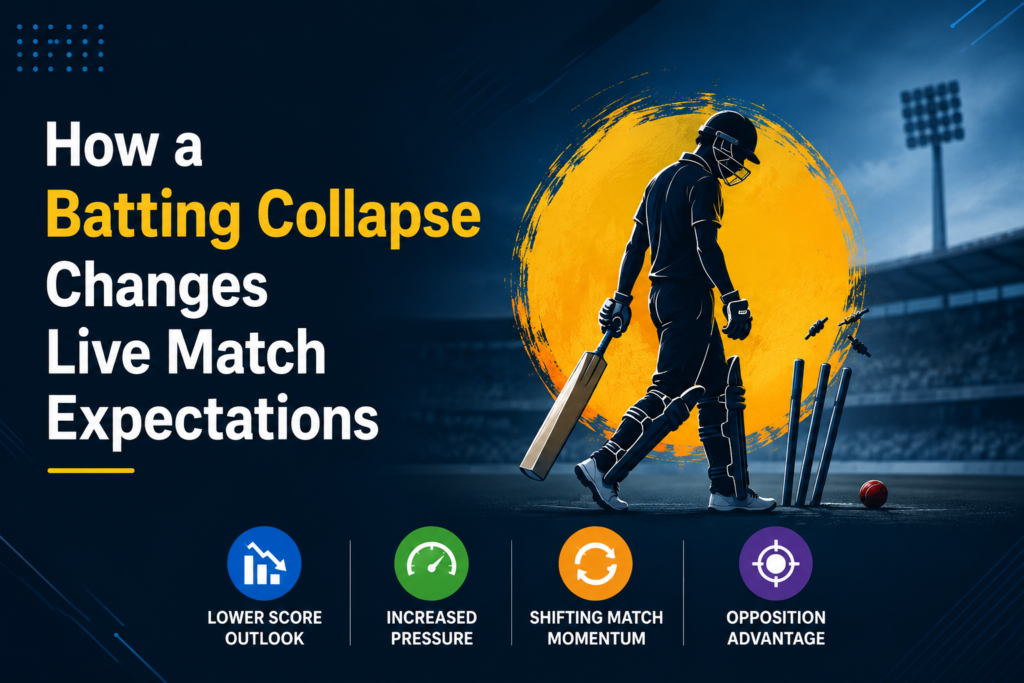
A cricket match can look comfortable for one side and completely different a few overs later. A few quick wickets can remove established batters, increase pressure on the lower order, and change the way both teams approach the remaining overs. For anyone following Tigerexch understanding this shift is useful because live match expectations are influenced by what is happening on the field, not simply the score.
A batting collapse usually means several wickets fall in a short period, often after the batting side appeared to be in control. The effect can be much bigger than the number of runs lost. A collapse can remove set batters, break partnerships, reduce scoring options, and force new players to face the most difficult phase of an innings.
The key point is simple: a batting collapse does not automatically mean the batting team will lose. Its significance depends on the score, wickets remaining, required run rate, batting depth, conditions, and time available.
What Is a Batting Collapse in Cricket?
A batting collapse occurs when a team loses multiple wickets in a relatively short period and struggles to maintain its previous scoring rate.
There is no single official number of wickets that defines a collapse. Losing three wickets for 15 runs can be serious in one situation but manageable in another. The context matters.
For example, consider two T20 situations:
| Situation | Score | Wickets | Interpretation |
| Team A | 120/2 | 2 | Strong position |
| Team A | 135/6 | 6 | Pressure increasing |
| Team B | 80/2 | 2 | Still building |
| Team B | 82/5 | 5 | Significant collapse |
The second example shows why the number of runs scored is only part of the story. Losing three wickets for two runs can have a greater effect than losing three wickets while scoring 30.
A collapse becomes particularly damaging when key batters are dismissed together and the incoming players have limited time to settle.
ICC match reports have repeatedly highlighted how quickly a match can change after a cluster of wickets. In one famous example, India moved from 277/1 to losing nine wickets for only 46 additional runs.
Why Does a Batting Collapse Change Live Match Expectations?
The first major change is the loss of batting resources.
A team with two established batters at the crease may have several scoring options. Once those batters are dismissed, new players have to rebuild the innings while facing the same bowling attack.
This creates several immediate effects:
- The scoring rate can slow.
- The required run rate can rise.
- Risky shots become more tempting.
- New batters face greater pressure.
- The bowling side can attack with more aggressive fields.
- Partnerships become more important.
- The remaining batting depth becomes a major factor.
A collapse also changes the psychology of the innings. One wicket can create pressure, while another soon after can make the batting side more defensive or force unnecessary attacking shots.
ICC reporting has documented similar situations where losing several wickets quickly removed momentum and changed the direction of a chase.
Tigerexch and the Importance of Reading the Match Context
Live cricket expectations should never be judged from one number.
If a live exchange market changes after three quick wickets, the movement reflects changing expectations around the match. But the market itself should not replace cricket analysis.
A better approach is to ask:
- How many runs are still required?
- How many overs remain?
- How many wickets are available?
- Which recognised batters are still at the crease?
- Is the required run rate increasing?
- Are the bowlers creating genuine pressure?
- What are the pitch and weather conditions?
- Does the batting side have reliable lower-order contributors?
This approach gives more context than simply watching a market move.
The First Wicket After a Stable Partnership Can Matter Most
Not every wicket has the same impact.
Suppose a team is 100/2 after 12 overs. Two established batters have built a partnership and the required rate remains manageable. If one of them falls, the situation may not immediately become dangerous.
The next few deliveries become more important.
If the new batter survives and the partnership begins again, the wicket may have limited long-term impact. But if another wicket follows within the next over, pressure can increase sharply.
This is why a collapse is often about sequence rather than individual dismissals.
A single wicket is an event.
Three wickets in ten balls can become a pattern.
That distinction is important when reading a live innings.
Batting Depth Determines How Serious the Collapse Is
The same collapse can have different consequences for different teams.
A side with several recognised batters and capable all-rounders may recover from 70/4. Another side with a long tail may struggle from the same position.
When assessing a collapse, look at the players still available.
Strong batting depth
A team may still have:
- An established middle-order batter
- An experienced finisher
- One or more genuine all-rounders
- A lower order capable of contributing runs
In this situation, losing three wickets does not necessarily end the innings.
Limited batting depth
The situation becomes more difficult when:
- Most specialist batters are already out.
- Tailenders are approaching the crease.
- The remaining batters have little experience.
- The required rate is already high.
- The bowling side has several overs from its strongest bowlers remaining.
This is where a collapse can quickly turn from a temporary setback into a major match disadvantage.
Required Run Rate Can Turn Pressure Into a Crisis
In a chase, the required run rate is one of the clearest indicators of changing pressure.
Imagine a team needs 80 runs from 60 balls.
The required rate is 8 runs per over.
Now suppose three wickets fall quickly and only 45 balls remain. The team may still need most of those 80 runs.
The required rate has increased to approximately 10.67 runs per over.
That difference changes the batting strategy.
Batters can no longer simply rotate the strike. They may need boundaries, which increases the risk of dismissal.
This can create a cycle:
Wickets → higher required rate → greater scoring pressure → riskier shots → more wicket opportunities
However, the cycle can also be broken by one strong partnership.
Partnership Size Can Reveal Whether the Collapse Is Over
After a collapse begins, the next partnership deserves close attention.
Suppose a team falls from 110/2 to 125/5.
The immediate concern is obvious.
But if the next two batters add 50 runs without losing another wicket, the match may begin moving in the opposite direction.
A recovery partnership can:
- Reduce the required rate.
- Give the batting side time to settle.
- Force the bowling captain to change plans.
- Move fielders back.
- Create new scoring opportunities.
- Restore confidence.
This is why it is dangerous to assume that a collapse continues indefinitely.
A batting collapse is a phase of the innings. It can end.
Bowling Pressure Often Explains the Collapse
Wickets rarely fall in isolation.
A good bowling spell can create the conditions for a collapse through disciplined lines, changes of pace, movement, spin, or pressure on scoring areas.
For example, a bowler may concede very few runs for several overs. Batters then attempt a higher-risk shot to break the pressure, resulting in a wicket.
The next batter faces the same pressure.
That is how one dismissal can develop into several.
ICC analysis of major collapses has shown how wicket-taking deliveries, bowling plans, and pressure can work together to dismantle a batting order.
Pitch Conditions Can Make a Collapse More Significant
The condition of the pitch also matters.
A collapse on a flat batting surface may suggest poor shot selection or exceptional bowling. A collapse on a difficult pitch may be less surprising.
Look for signs such as:
- Uneven bounce
- Excessive movement
- Slower surface
- Ball gripping for spinners
- Two-paced conditions
- Reverse swing later in an innings
- Dew affecting the ball
A batter may look completely comfortable for one spell and struggle when conditions change.
This is why the score alone cannot tell the complete story.
Overs Remaining Matter as Much as Wickets
Time is another major factor.
A collapse with 15 overs remaining is different from a collapse with three overs remaining.
In a T20 chase, losing four wickets with 18 balls remaining can leave very little time for recovery. In an ODI, the same number of wickets with 15 overs available may leave enough opportunity for a partnership.
The longer the remaining innings, the more opportunities a team has to rebuild.
The shorter the remaining innings, the more damaging each wicket can become.
A Collapse Does Not Always Mean Defeat
This is one of the most important points for live cricket analysis.
Teams recover from difficult positions regularly.
A batting side may lose four wickets quickly and still win because:
- The target is relatively small.
- A set batter remains at the crease.
- An experienced finisher is available.
- The pitch becomes easier to bat on.
- The bowling side runs out of its strongest options.
- A large partnership develops.
Historic cricket provides plenty of examples where a dramatic collapse changed expectations without making the result certain. ICC has documented matches where teams appeared to have control before a late series of wickets completely changed the contest.
So the better question is not:
“Did they collapse?”
It is:
“What resources remain after the collapse?”
How to Judge the Severity of a Batting Collapse
A simple framework can make live analysis easier.
1. Compare the wickets with the runs lost
Three wickets for 10 runs is generally more alarming than three wickets for 40 runs.
2. Identify who was dismissed
Losing a lower-order batter is not the same as losing the team’s top scorer or a batter already well set.
3. Check the required rate
A manageable required rate gives the batting side room to recover.
4. Count the remaining recognised batters
This tells you how much batting capacity remains.
5. Watch the next partnership
A new partnership can stabilise the innings and reduce pressure.
6. Consider the bowling attack
If the bowling side still has its strongest overs available, recovery may be harder.
7. Assess the conditions
Pitch behaviour, dew, movement, and grip can all change the equation.
This framework is more reliable than focusing on the latest wicket alone.
Common Mistakes When Reading Live Match Momentum
Mistake 1: Treating every wicket as equally important
A wicket in the final over is different from a wicket during a settled middle-overs partnership.
Mistake 2: Ignoring batting depth
The score may look poor, but six capable batters could still remain.
Mistake 3: Looking only at the required run rate
A high required rate matters, but a strong batter at the crease can change the calculation quickly.
Mistake 4: Assuming market movement equals certainty
Exchange prices represent changing expectations. They are not guarantees of a result.
Mistake 5: Ignoring the bowling spell
A collapse may be temporary if the attacking bowler completes their spell and weaker options take over.
Mistake 6: Forgetting the match format
A collapse in Test cricket has a different meaning from one in an ODI or T20 match.
Batting Collapse: Test vs ODI vs T20
| Format | Effect of Collapse | Main Recovery Factor |
| Test | Can affect an entire innings or match session | Time and partnerships |
| ODI | Can reduce a competitive total quickly | Overs remaining and batting depth |
| T20 | Often has an immediate impact | Remaining balls and finishing ability |
The shorter the format, the less time there is to recover from lost wickets.
In T20 cricket, losing three wickets in a short period can immediately change the required scoring strategy. In Test cricket, a similar sequence may still leave plenty of time for a partnership to rebuild.
A Practical Example
Imagine a team chasing 170 in a T20 match.
After 12 overs:
105/2
The team needs 65 from 48 balls.
That is a manageable position.
Now three wickets fall in the next 12 deliveries, leaving the score at:
112/5
The required runs have not changed much, but the situation has.
The batting side has:
- Fewer established batters.
- Less stability at the crease.
- More pressure on incoming players.
- Greater dependence on boundaries.
- Less margin for another wicket.
Now suppose the next two batters add 35 runs from 20 balls.
The score becomes:
147/5 after 15.2 overs
The match has changed again.
The collapse created pressure, but the recovery partnership reduced it.
This example demonstrates why live expectations should be updated continuously rather than based on one moment.
How Readers Can Follow a Collapse More Objectively
When watching a live match, avoid making a judgment after every delivery.
Instead, review the situation every few overs or after a major sequence of events.
Ask:
Score: Is the team ahead or behind the expected scoring position?
Wickets: How many remain?
Batters: Who is currently at the crease?
Required rate: Is it rising or falling?
Partnership: Is the current pair rebuilding?
Bowling: Which bowlers remain?
Conditions: Are they helping batting or bowling?
Time: How many overs or balls remain?
This creates a more balanced picture.
For readers following cricket exchange markets, the same process can help separate genuine match developments from short-term reactions.
Key Takeaways
- A batting collapse means several wickets fall in a relatively short period.
- The seriousness of a collapse depends on context, not simply the number of wickets.
- Losing established batters can have a larger effect than losing lower-order players.
- Required run rate becomes especially important during a chase.
- Batting depth determines how easily a team can recover.
- A strong partnership can reverse the pressure created by a collapse.
- Bowling quality and pitch conditions can explain why wickets are falling.
- A market movement should not be treated as a guaranteed prediction.
- The shorter the format, the less time a team has to recover.
- Responsible cricket analysis should focus on evidence from the match rather than emotional reactions.
Conclusion
A batting collapse can transform a cricket match within a handful of deliveries. What looked like a comfortable chase can suddenly become a difficult one when established batters disappear and the required rate starts climbing.
But a collapse is not the final answer. The remaining batting depth, wickets in hand, partnership potential, bowling attack, pitch conditions, and time available all determine how serious the situation really is.
For anyone following Tigerexch, the most useful approach is to understand these cricket fundamentals before interpreting changing live expectations. The same applies when using the Tiger exchange app or following exchange-market information elsewhere.
Live cricket can change quickly, so decisions should never be based on a single wicket, score, or market movement. If engaging with betting or exchange services, use them responsibly and within applicable laws and personal limits.
FAQs
1. What is a batting collapse in cricket?
A batting collapse occurs when a team loses several wickets over a short period and struggles to maintain its previous scoring rate. The impact depends on the score, wickets remaining, batting depth, required rate, and match conditions.
2. Does a batting collapse always mean a team will lose?
No. A team can recover through a strong partnership, especially when experienced batters remain at the crease. The target, overs remaining, bowling attack, and batting resources all matter.
3. Why does losing wickets increase pressure in a chase?
Wickets reduce the number of available batters. If the required runs remain high while wickets fall, remaining batters may need to score faster, increasing the risk of further dismissals.
4. What should I check after a batting collapse?
Check the current score, wickets, overs remaining, required run rate, batters at the crease, remaining batting depth, bowling options, and pitch conditions.
5. Can one partnership reverse a batting collapse?
Yes. A stable partnership can reduce the required run rate, rebuild confidence, and force the bowling side to change its tactics.
6. Why can a live exchange expectation change so quickly after wickets?
Several quick wickets can alter the perceived probability of each team’s success. However, changing exchange expectations are not guarantees and should be considered alongside the actual match situation.
7. Is a collapse more damaging in T20 cricket?
It can be because fewer balls remain to rebuild the innings. A team losing several wickets with only a few overs left has less opportunity to recover than a team in a longer format.
8. How does batting depth affect a collapse?
A team with several capable batters remaining can often absorb a few wickets. A team approaching its lower order may face much greater pressure after the same number of dismissals.
9. Can pitch conditions cause a batting collapse?
Yes. Movement, uneven bounce, grip, a slow surface, or changing conditions can make scoring difficult and increase wicket-taking opportunities.
10. What is the biggest mistake when analysing a collapse?
The biggest mistake is judging the match from wickets alone. A proper assessment should combine wickets with the score, required rate, remaining batting resources, bowling attack, conditions, and time left.